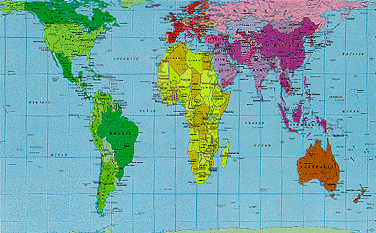
It’s been a long time coming. I became aware of the Peters Map a couple of years ago. A friend has one on their office wall, a huge one, and I can look at this thing for ages and not get enough. What the hell am I talking about? I’m talking about a map of the world that shows actual sizes of continents and oceans in proportion to each other, instead of showing (for example) Europe and N. America as giant compared to “little” continents like South America and Africa. The Peters map projection has brought with it the idea that maps are political. If you want, you can read more.
The Peters Projection World Map is one of the most stimulating, and controversial, images of the world. When this map was first introduced by historian and cartographer Dr. Arno Peters at a Press Conference in Germany in 1974 it generated a firestorm of debate. The first English-version of the map was published in 1983, and it continues to have passionate fans as well as staunch detractors.
The earth is round. The challenge of any world map is to represent a round earth on a flat surface. There are literally thousands of map projections. Each has certain strengths and corresponding weaknesses. Choosing among them is an exercise in values clarification: you have to decide what’s important to you. That is generally determined by the way you intend to use the map. The Peters Projection is an area acurate map.
Here’s a small version:
Check out their web site .
Another tidbit (this is part of what got me thinking) from this page:
Which is bigger, Greenland or China? With the traditional Mercator map (circa 1569, and still in use in many schoolrooms and boardrooms today), Greenland and China look the same size. But in reality China is almost 4 times larger! In response to such discrepancies, Dr. Arno Peters created a new world map that dramatically improves the accuracy of how we see the Earth.
Mercator’s projection (created at a time when navigators were sailing on the oceans in wooden ships, powered by the wind, and navigating by the stars) was particularly useful because straight lines on his projection were lines of constant compass bearing. Today the Mercator projection still remains useful for navigational purposes and is referred to by seafarers and airline pilots.
The Mercator is also a “conformal” map projection. This means that it shows shapes pretty much the way they appear on the globe. The mapmaker’s dilemma is that you cannot show both shape and size accurately. If you want a true shape for the land masses you will necessarily sacrifice proportionality, i.e., the relative sizes will be distorted.
I want one!!! That is awesome…I think I just found my husband’s Christmas present…
The other day my husband mentioned that from the tip of Alaska’s islands to the other side of the state is nearly as long as the entire “continental” US. Seems crazy but with this map, it looks possible.